
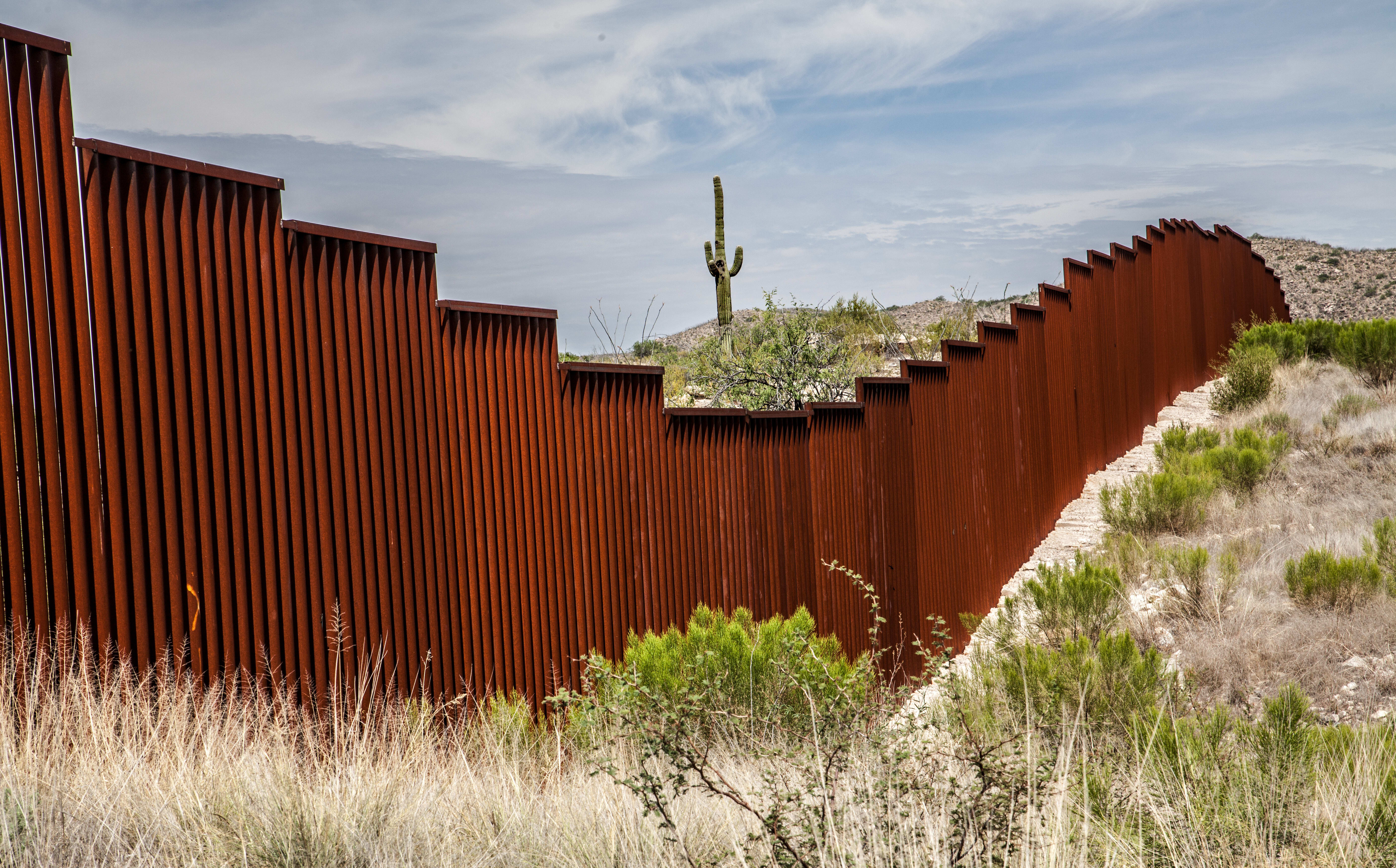

Arizona is a border state, and we have heard a lot about border security in the news recently. We were curious and wanted to learn more, and we thought our readers might find our research interesting. This post includes some of what we discovered: a historical background, context, and an overview of current policies along with links to references we have curated from academia, government, think tanks and centrist media organizations. Up until this point, we had not done a deep dive into this topic, and we learned a lot! If you’ve also wanted to know more about border security, we hope you find our research useful.
HISTORY
Mounted watchmen operated on the U.S. border in Texas as early as 1904. In 1915 “Mounted Guards” with arrest authority were
authorized by Congress; they mostly pursued Chinese immigrants trying to avoid Chinese exclusion laws. The first “Immigration Border Patrolman” was a Texas Ranger (later on an Arizona resident) named Jeff Milton. Other than his ashes being scattered in the Arizona
desert, not much is disclosed about Milton. Beginning in 1917, larger tax and literacy requirements imposed upon immigrants wanting to enter the United States led more people to try to enter illegally. Following the passage of prohibition in 1920, numeric limitations on the number of immigrants allowed into the United States were established by the Immigration Acts of 1921 and 1924. The U.S. Border Patrol was officially established in 1924. In 1932 two directors were established for the Border Patrol, one in Mexico and one in Canada. In 1934, the first Border Patrol academy was established. By 1940, there were 1,531 border patrol officers and an additional 1,400 civilian employees. Illegal immigration was an ongoing issue along the Mexican border, and in 1952, the government flew 52,000 illegal immigrants back to the Mexican interior. The funds for this effort quickly ran out; it was terminated during its first year. Private planes carried substantial numbers of illegal immigrants into the U.S.A. in the late 1950s, and the border patrol was tasked with stopping these flights. Aircraft hijacking attempts occurred in the early 1960s, and Border Patrol agents were ordered to escort domestic flights to thwart takeovers. Significant increases in illegal migration to America were seen in the 1980s and 1990s. Among the responses led by Border Patrol were increases in staff and use of technology to deter migrants. Following the terrorist attacks of September 11, 2001, homeland security became a primary concern of the nation. Since then, there has been a renewed interest in border security in Washington, D.C., and among citizens.
In Arizona, the Tucson Sector covers most of the state from the New Mexico State line to the Yuma County line, a total of 262 border miles. It is one of the most active sectors in the country in terms of illegal immigrant apprehensions and marijuana seizures. There are currently approximately 3,700 agents working at nine stations in the Tucson Sector. The nine stations are located in Why, Casa Grande, Tucson, Nogales, Willcox, Sonoita, Bisbee, Douglas, and Three Points.
THE LEGAL SITUATION
Migrants entering the United States without a visa may claim political asylum. According to current law, anyone physically present on US territory, regardless of how or where they arrive, regardless of whether they have authorization, is allowed to request asylum. Individuals arriving without authorization can be deported using a governmental process called “expedited removal” by Border Patrol or
other Customs and Border Protection (CBP) without going to immigration court officials, but if an individual asks for asylum, expedited removal is not an option. Immigrants requesting asylum are initially questioned to determine if they have a “credible fear” of persecution
in their home country. If an immigrant is found to have a credible fear, they are permitted to pursue their asylum claim in the United States through immigration court.
Currently, our nation is woefully short of immigration judges and courts, and a typical asylum claim takes from five to seven years to adjudicate. Federal courts will not allow most migrants to be detained for such a long time, because they have not been found guilty of a crime and there is not enough space in detention facilities to house millions of asylum applicants. The judicial process for family groups with children is even more strict. Therefore, asylum applicants are required to be released until their cases can be heard by an immigration judge.
U.S. law currently states that asylum applicants cannot legally work in our country for six months after their asylum claim has been filed in immigration court or with the Department of Homeland Security’s (DHS’) US Citizenship and Immigration Services (USCIS). This law cannot be changed by the executive branch. During the six months until migrants get a work authorization document from USCIS or a
decision on their asylum claim, they have no way to make a living. These asylum seekers rely on public aid, funds from relatives, friends, or charities, or work without legal authorization. More than half of all asylum applications are denied; however, many asylum seekers are allowed to live and work in the United States for five to seven years until they receive the final decision on their asylum case. Even then, many asylum seekers will not be sent home. Public opinion polls show that most Americans want an immigration system that is just and fair, allowing deserving immigrants to get asylum and denying those who do not meet the criteria.
WHAT'S BEEN HAPPENING RECENTLY
The Fiscal Responsibility Act of 2023 limited the budgets of the departments that collectively fund the border and immigration systems (Homeland Security, Justice, Health and Human Services (HHS), and State Department). During the years of 2024 and 2025, the only way for these departments to get additional funds is through emergency supplemental appropriations.
As requested by Republican lawmakers in October, the Biden administration presented a border supplemental along with their request to fund the war in Ukraine. The funds requested were intended to increase the capacity of the system to process asylum seekers. Specifically, the funds were to be used to increase the number of immigration judges, a substantial increase in the budget of Customs and Border Patrol (to provide security) and FEMA (to provide shelter/services to asylum seekers), more attorneys for asylum cases, increase in funding for law enforcement (DEA, FBI) including genetic testing kits to ensure children are in fact related to supposed parents, and an increase in refugee/migration assistance through the Department of State.
Legislators spent more than ten weeks in late 2023 negotiating the details of a bipartisan bill in the Senate which was the first serious effort in more than a decade to combine policy changes and resources required to improve the situation at the border. The bipartisan Senate deal offered more money for border and immigration security ($20.3 billion) than the Biden administration had requested ($13.6 billion). There were also major shifts in the bipartisan bill with regard to how the money was allocated. See the graph below for details.
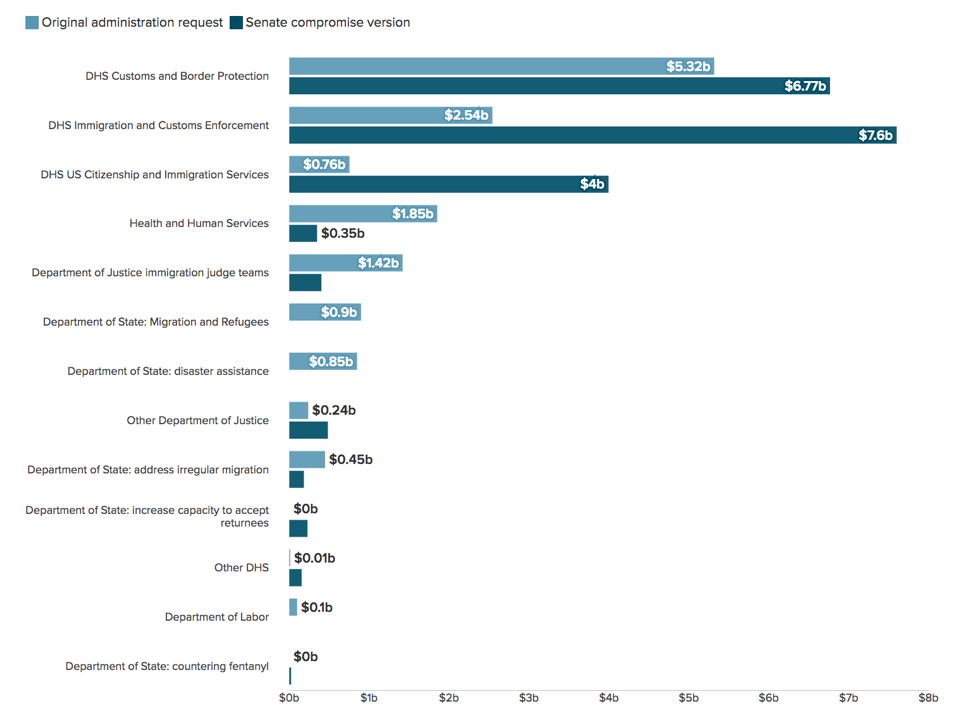
Combining military assistance to Ukraine and Israel with more money for border security and migration came about in late 2023. Due to the Biden-McCarthy June budget deal, the only way to get additional funds was through an emergency supplemental appropriation.
Customs and Border Protection ceased operations in Lukeville, Arizona the border crossing to address an increase in migrant crossings on December 4, 2023, this essentially closed the busiest border crossing to Puerto Peñasco (commonly known as Rocky Point). This action allowed the reassignment of port officers to help Border Patrol agents process hundreds of migrants arriving a mile to the west in the desert. Arizona National Guard troops were deployed to the area by Gov. Katie Hobbs, and the Lukeville crossing was reopened by Customs and Border Patrol a month later on January 4, 2024. The closure of the Lukeville Port of Entry caused significant social and economic effects on both sides of the U.S.-Mexico border.
Meanwhile, Republicans insisted immigration policy changes must be a condition for passing additional military assistance to Ukraine in November. For ten weeks, a group of Republicans and Democrats in the Senate worked on a bipartisan compromise announced on February 4th. Just as bipartisan Senate compromise was to be released, former president Donald Trump said on social media “I do not think we should do a Border Deal, at all, unless we get EVERYTHING needed to shut down the INVASION of Millions & Millions of people, many from parts unknown, into our once great, but soon to be great again, Country!”
This social media post led Speaker of the House Mike Johnson to deem the deal “dead on arrival” even though details of the deal had yet to be released. On February 11, the Senate voted 67-27 to move forward with funding for the Ukraine, Israel, Indo-Pacific, and humanitarian packages but refused to pass funding for improved border security and immigration.
Another year of not having adequate resources to deal with the current number of arriving migrants will obviously further strain the nation’s immigration system.
WHAT ARIZONA’S ELECTED OFFICIALS HAVE BEEN SAYING AND DOING
In May 2023, as a result of conversations with Arizona border leaders, Rep. Gallego (AZ-03) sent four letters to Biden Administration officials and Congress with specific resource requests for border communities which would reduce the burden of processing immigrant arrivals.
In June, Gallego sent a letter to the Federal Emergency Management Agency (FEMA) contending that Arizona needs additional funding to tackle border crossings and deliver services.
After what Gallego felt was an insufficient reaction from FEMA, he sent a letter to Secretary of Homeland Secretary Alejandro Mayorkas, expressing his dissatisfaction with the funding model.
Rep. Gallego then sent another letter to FEMA asking that a new documentation requirement straining border groups and non-profits in Arizona be withdrawn.
In September, after Rep. Gallego sent the letters and communicated by phone with Sec. Mayorkas, Rep. Gallego announced $2 million in emergency funding had been secured from the DHS to assist Arizona’s border communities.
Rep. Gallego worked with Rep. Michael McCaul (TX-10) in November to send a bipartisan letter asking that funding to support first responders in communities impacted by immigration be included in FY 2024 supplemental appropriations.
On November 2, 2024, Rep. Schweikert (AZ-1) introduced HR 765, a resolution that opposed any proposal or legislation that would financially support individuals crossing the border illegally.
At around the same time, having consulted with Arizona non-profits, leaders of border communities, and law enforcement officials, Rep. Gallego shared a plan to reform FEMA’s Shelter and Services Program (SSP) that he said should increase funding to Arizona’s border communities.
In December, Rep. Gallego asked the Biden Administration to make an emergency declaration on the Southwest Border to provide the resources required to humanely address the increased number of border arrivals. An inquiry was also made about the use of National Guard facilities in Douglas, Arizona as emergency migrant shelters. During the same timeframe, Gallego met with local stakeholders
in Yuma to learn about the impact closing the Lukeville Port of Entry had on Arizona’s economy. He also visited Nogales, Bisbee, and Tucson, meeting with local leaders to discuss the effect of increased migration on Arizona’s border communities.
Rep. Gallego introduced the Buck Stops Here Act to stop fentanyl from coming in through the border. Two fentanyl-related provisions were also secured in the annual defense bill. Most Fentanyl that crosses the border comes through at the ports of entry and is transported by American citizens; the most recent data shows that U.S. citizens were 86.3 percent of convicted fentanyl traffickers. Furthermore, only 0.02% of people crossing the border illegally possessed any amount of Fentanyl.
In a letter, Rep. Gallego asked Speaker Mike Johnson to address the needs of Arizona’s border communities in any supplemental funding package. Letters were also sent to Secretary of Transportation Pete Buttigieg and Secretary of Homeland Security Alejandro Mayorkas asking the Administration to address the problem of foreign travel agencies promoting travel to our Southern border, often through human smuggling organizations.
On February 7, 2024, Sen. Sinema released a list of bi-partisan local and national leaders who supported her federal bipartisan immigration bill. The list included: Yuma Mayor Nicholls, Mesa Mayor Giles, Casa Grande Mayor McFarland, The Greater Phoenix Chamber of Commerce, Governor Katie Hobbs, former Governor and Secretary of Homeland Security Janet Napolitano, the president of the Arizona Farm Bureau, and the National Border Patrol Council.
Sen. Kelly and Sen. Sinema publicly expressed frustration that the bipartisan immigration bill did not pass on February 8, 2024.
On February 14, 2024, Rep. Justin Heap, a Mesa Republican, announced House Bill 2843 saying it was written to close a loophole
that he believes has led to “increasingly larger numbers of migrants or human traffickers moving across farm and ranch land.” The bill enlarges the Castle Doctrine law by allowing the use of deadly force if an intruder is either in the shooter’s residence or on his land. Currently, The Castle Doctrine states that the intruder must be both on the land and in the residence or other structure designed for habitation for deadly force to be acceptable. If passed, this modification state law would provide a much wider defense to
people who use deadly force on their property. Arizona has a law on the books that does not require a property owner to retreat first before taking violent action. The Arizona State House approved HB 2843 on Feb. 22 by a 31-28 vote, Republicans were in favor
and Democrats opposed. The Senate will now deliberate the bill.
Also on Feb. 14, 2024, Congressman David Schweikert (AZ-1) signed a letter with 114 Republican colleagues to President Biden imploring that the Administration address the Fentanyl coming through the southern border. AGAIN: Most Fentanyl that crosses the border comes through at the ports of entry and is transported by American citizens; the most recent data shows that U.S. citizens were 86.3 percent of convicted fentanyl traffickers. Furthermore, only 0.02% of people crossing the border illegally possessed any amount of Fentanyl.
Following the release of the bipartisan Senate border package in February, Rep. Gallego released a statement in support of the deal and called out the legislators who prevented its passage.
On February 26, 2024, Rep. Ruben Gallego announced growing support for his First Responders Emergency Assistance Act, legislation that would establish a new emergency grant package for law enforcement and first responders in communities facing increased migrant arrivals. The program was first announced last year as part of Gallego’s plan to support Arizona’s border communities.
On February 28, 2024, Arizona SB 1231 was sent to Gov. Katie Hobbs. SB 1231 would allow state and local police to detain migrants they believe are illegally entering via the southern border between ports of entry and would allow Arizona judges to issue orders of deportation. The Bill has passed both the Arizona Senate and House, despite concerns about racial profiling and the Constitutionality of such a bill, given the federal government’s sole authority to enforce immigration policy.
On February 29, 2024, Arizona Sen. Kyrsten Sinema and Sen. Mark Kelly sent a letter urging the House and Senate Appropriations Committees to earmark a minimum of $752 million in U.S. Customs and Border Protection (CBP) Shelter and Services Program (SSP) funds in the annual Homeland Security funding bill.
WHAT HAPPENS NEXT
The federal bipartisan border compromise had some important elements that could be part of the framework for creating new policy:
- Border security and immigration policies must be linked to funding.
- Increased funding for the back-office functions to
process asylum and other immigration cases within weeks, not years is
essential. - DHS and Homeland Security need to become more non-partisan
These elements are a foundation on which to build a just and fair immigration system reflecting our American values.
RESOURCES:
https://www.cbp.gov/border-security/along-us-borders/history
https://mediabiasfactcheck.com/atlantic-council/
https://www.cbp.gov/border-security/along-us-borders/border-patrol-sectors/tucson-sector-arizona
https://www.sinema.senate.gov/arizonans-endorse-sinemas-border-security-bill/
https://www.ussc.gov/research/datafiles/commission-datafiles
https://www.allsides.com/news-source/cato-institute
https://www.cato.org/blog/fentanyl-smuggled-us-citizens-us-citizens-not-asylum-seekers